
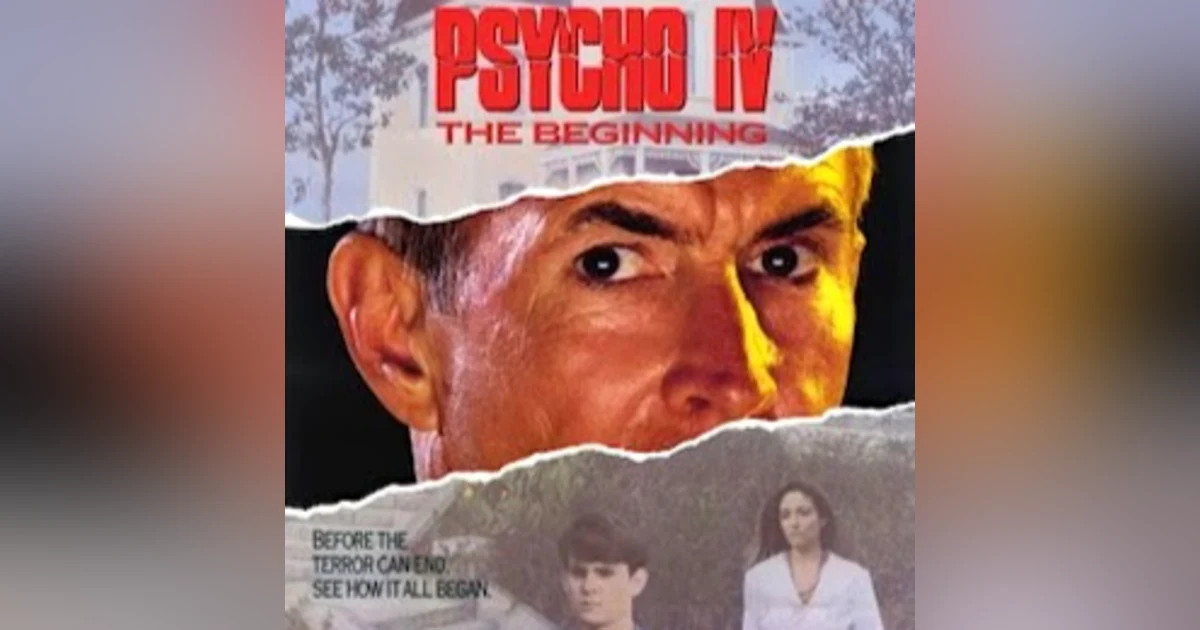
PSYCHO IV: THE BEGINNING


 Spotify

 Apple Podcasts

 Castro

 RSS Feed
This week the crew is joined by Kinnel from Sinister Cinema to talk about the final entry in the main Psycho series. It may be the only movie ever greenlit in order to promote the opening of a theme park. This made-for-cable movie was written by the original film’s writer Joesph Stefano, but it’s clear that without Hitchcock, the screenwriter was a one trick, “boy I sure do like Sigmund Freud” pony. The crew is talking about weird incest, talk radio tomfoolery, Anthony Perkins giving director Mick Garris the what for on set, and so much more.
Please take a moment to rate and review us on the Apple Podcast app, or rate us on the Spotify app. Reviews and five star ratings help new listeners find us every day, and we greatly appreciate the feedback and support.
Patreon members get exclusive full length episodes, audio fan commentaries, exclusive mini-sodes and more. Join today for as little as $2 at patreon.com/podandthependulum.
Check out our website for easy access to our full catalog of shows, with hundreds of hours of free content. You can search the catalog, leave a review and even leave us feedback all from the site. Go to www.podandthependulum.com to check it out.
Follow us-
Like what you're hearing? Please rate, review & subscribe to us on Apple Podcasts (or wherever you get your shows) so more people can discover us.
Follow us on Twitter: @podandpendulum
Become a patron today for more bonus content and full length exclusive episodes: patreon.com/podandthependulum
0:35 None. Hello everyone, and welcome to the Pod and the Pendulum, the podcast cut that covers all the horror franchises, one movie and one episode at a time. This week we are barreling right along with our coverage of the Psycho franchise. As always, I'm your host Mike Snoonian, and I am not alone. We have three Co hosts and a special guest sitting in the chairs today for this movie of all movies where like everyone's like I'm in. It's always a shock, always a surprise. Up first from Bloody Disgusting in the new podcast Holy Terrors. Mr. Brian Kuiper, how are we? Good. I'm fine. I actually slept last night, so I'm feeling pretty pretty well. Yeah.
1:17 For a change. This, like, never happens. Excellent. You have no idea what we're in for. Let's see what we get from you today. Yeah. Also joining us as a Co host today, Mr. Steven Foxworthy. How are we? Doing well Mike. World class bitch reporting for duty. Love it. All right. Also with us back again. She is the host of the Bodies of Horror podcast. She's been on a red eye flight just to make this episode. Miss Nicole Gobel. Nicole, how are we this morning besides sleepy? I'm doing great. Nothing like burning the midnight oil with some good old CCH pounder.
1:57 Yeah. To get this in, it's been a long time since I've seen this one, so I'm really excited to talk about it. Now were you on the flight home like going through the airline kind of like video on demand menu going like where is psycho 4 like how is this not one of the offerings? Well. Of course that was #1 because I did want to make sure I was able to, like, have it on the screen so that my little role mates could enjoy this film vicariously. But that wasn't a possibility. Shock of shocks. So I did what? Airline so I never fly with them just. Correct, JetBlue, so I be.
2:44 So I got a little enterprising and made sure it was on my iPod and not my iPod, my iPad. OK, I'm not that old and I made sure to also have it positioned so that, again, I don't want to rob people of the experience of this film. Did you act any of the scenes out for the pleasure of the cabin? I did I. Little community theater. I ended up getting on the PA system and just doing like my own radio show. Love it. Yeah. That's amazing. Love it. Oh, my goodness, kid. Also joining us today is a special guest from overseas. You heard him last week on Cycle 3. It's Kennel.
3:31 How are we? Yes, lad, how are we doing? Oh, Jordia. Doing fantastic. It's a pleasure to have you back on. Brian has hopped off the episode apparently, like he's like radio show. That gives me an idea. And maybe that's what he's doing right now. No, he just he got flashbacks of his showing of me in streets the other day when everyone but him walked out. Everybody left, so by the end of this episode, it'll just be me. Fantastic. All right, well, let's dive into it. Nicole, what are your initial memories of watching Psycho 4 when it wasn't on an airplane? Yeah, so this was definitely one that I caught on cable.
4:12 And you know, I think like with all franchises, but especially franchises that have such an important entry into kind of the poor zeitgeist, I think you anticipate such diminishing returns with each outing. I'm not just like they're running a little bit low on story fuel. It's kind of like, what in the hell is even worth continuing the story? But surprisingly, I don't hate a lot of these sequels. I think they really, really, really try to make it work. So I remember watching it on cable and being like, what is this like a kind of like a going back and giving us a little bit of like more centered story on Norman's use so that we could kind of review some of those other films with a different lens.
5:14 So that's kind of where I'm kind of focused. On. Viewing. But yeah, it'd been a while, so I was glad to to pop this one back on. Excellent canal. How about yourself? Flippin I have it in the head that I watch the Psycho films all the time, but Revelation I found I hadn't watched it since like the first week of COVID when I checked my letterbox, I I had like I rated it four stars at the time. Flippin I had it in my head that this is a really, really good film, what you call it, but a bit of a fall off. But I think I might have like, sort of rearrange things retroactively in my head because I think what was normally happening previously is I hadn't watched a Psycho film in ages. I'd catch this one, think, oh, that's all right, I'll watch another one.
6:05 And then how? And then I just remember having a really good day watching Psycho films. I've never like watched them. I don't think I've ever really watched them consecutively in release order. And it's affected how I feel about it to some degree. Excellent. I don't think it's a bad film, but the drop off is real. I mean, you go. From I've got my theories, like obviously there's stuff like, you know, it being sort of made for television, all this kind of thing. But like, well, I've got my theories, we'll get into them. I mean, I don't want to be shots fired, but when you go from Mick Garris to Alfred Hitchcock, like back-to-back, there's going to be a drop off.
6:51 I do kind of think it's a Mick Garris problem. Like, like, I mean, Mick Garris is like, like, I quite like him as a character. I quite like him telling interesting stories and he coordinated great things. The actual stuff he's directed? Not so much. Yeah, we'll talk about that in a minute. I I definitely want to talk about Mick Garris a little bit and in a minute here. We've covered one of his films before. If you go back into the archives, we've covered Critters 2, which I think many would say is like his best film, and that's saying something. Steven, how about yourself? His best film by default, no.
7:32 So as if you've listened to the last two episodes, you know, this is my first engagement with Psycho 4. I watched it as we were as the recording time approach. So I'd like again, kind of right before the recording was watching this one. And yeah, it it feels like a pretty stark drop off. Is it future or is it past? It's one of those Godfather 2 style, straddling the line between prequel and sequel. But I think that's where the comparisons between those two films end, because this is doing. Things you think? I do. No, no, Brian, I don't think I insist. Good. This, this, this isn't doing either prequel nor sequel particularly well in my mind, so we can discuss that further.
8:15 This movie has a lot of the problems that I typically have with prequels kind of baked into the cake of the thing, and I know we'll talk about that later. I've got a big long list of notes on that toward the toward the movie discussion part of things, but there's a lot to like here. There are things I do genuinely like about this, but it's mostly toward the beginning. And but generally just the whole thing just feels really messy to me. And so, yeah, I, I didn't, I went in kind of wanting to wanting to enjoy this as I had, you know, the the previous films in this franchise. And and kind of this I think is where we start to fall off in my in my thinking. I would agree. I I think we're on the same page. Brian, how about yourself? Well, I apologize for a minute ago. So my microphone probably sounds a little bit different now than it did in the introduction.
9:01 So sorry about that. OK, I remember my grandma having Showtime, so I'm pretty sure that I watched it with her and I've mentioned her on the other Psycho episodes because that's she's like my experience with Alfred Hitchcock really begins with her. So all of these movies came were are connected to her. I also have a great Silence of the Lambs story concerning my grandma for another day. But I went and I also so I remember she hated it I'm sure and I thought it was OK and but didn't really remember anything about it. Also, when I went to Universal Studios Florida as a kid, they had built the Psycho House on the Hill. It was right outside of the Hard Rock Cafe. I remember this very distinctly.
9:55 I have pictures of it somewhere. Again, like I mentioned last week, they're in a box somewhere. Physical photos. That's just the way things are now. The physical photos are in a box. So if it hasn't happened in the past, you know, 10 years or so, I don't have it with me, but I have. I remember that so well. And that was just kind of a really key sort of moments like of movies are like physical things too. You know, there's, there's reality involved in this, you know, I don't know, that sounds weird. I don't know how to explain it, but it was a, it was a key moment and sort of there's a physical element to Psycho and that's really cool. And, and I it's within my actual visual distance sight. And I think I thought that was pretty amazing. So was the house itself in the theme park like where the rides were?
10:48 Or was it outside the park on like the boardwalk leading into the entrance? Well, The thing is, it's all really different now because it's all, it's all concrete there now. But back then, this was, you know, 1989 or so, there was it was just like you see in the film. I mean, it was just like an empty hill that actually looked like a California hill. You know, they made it look like a California hill. So it's sort of deserty looking and that all of that greenery and stuff, that sort of the wildflower stuff that is in front of it, that was all there. And the theme park itself felt like it was a long way away because like the city walk didn't really exist yet. Yeah.
11:37 Islands of Adventure was years away, Yeah, from existing. So it, it felt, you know, Universal Studios of the time felt kind of remote. It was just sort of out there in the swamp, you know, and they had things, but it's very different now than it was then. I mean, they even had like a studio tour thing going on at the Florida one at that time, which they don't really do anymore. They don't, really. Shoot anything there anymore? Right. But it was just so I remember very distinctly all of that stuff for whatever reason. Yeah, I know that like in the early he's like BUCW Wrestling shot their weekly television at Universal Studios at one of the lots in order to save money. They would and they would basically film like 2 months worth of weekly television in like 2-1 or two tapings. And it wasn't like real fans that were going into these tapings.
12:37 It was literally like whoever is at the park at the time or they would just pay like people off the streets like 50 bucks to sit in the stand. So nobody had any idea who any of these wrestlers were and like who to cheer or who to Boo. And it was just like a cost cutting measure. But it was like not the best product in the world. And they would do things like shoot title changes, and then someone would get injured before the episode aired. And it would cause all sorts of continuity problems. But because wrestling was for children, who cares? But I just remember what I remember about, like, Universal Studios in the 90s. And now it's, you know, it's a park that really rivals, like Disney World.
13:19 In terms of all the attractions, I prefer Universal over Disney World. Like if I'm going, you've been to the Universal twice in the past 10 years and never Disney World. Yeah, I, we went last summer and the thing that we really loved about Disney World was actually Animal Kingdom. We were going to spend a whole day there or two days there. As far as everything else went, Universal was the place to be. So we spent several days there. But Speaking of not great product, Psycho 4, beyond those couple of anecdotes, you know, sort of the personal connections, the movie, it really just doesn't do much for me at all. I'm I'm one of those people that I like to be able to fill in the answers for myself.
14:02 I don't like them spelled out so much. And so a prequel like this, I don't know, it was just sort of like it felt feels really unnecessary, very overly Freudian and dated in its psychology. And you know, Joseph Stefano and all that Freudian crap is just like, come on, man, let's do something more interesting, please. So anyway, that's that's part of the movie discussion I suppose though. I'm in the same boat. Like this was the first time Watch for me is a movie I had ordered like the three sequels from Scream Factory probably a little over a year or two ago, knowing that at some point we were going to get to the series.
14:44 So I might as well like own them. And you know, when you do that, like, you got to get 4 as part of that mix. And this week was like the first time I'd cracked it open, like in preparation for the show. And it's fine. Like, you know, we were saying off air, like sometimes you get a movie that's like egregiously bad and it's fun to do an episode on it because there's a lot you can say and have a lot of fun with it. Or it'll be next week. Maybe. We'll see. We'll see. I hate this you. Hate the sequel, I hate the remake. I hate it. I hate it. So it's gonna in Ari, it's gonna be on that episode, so it's gonna be Nosferatu all over again. It's gonna be fantastic.
15:25 That'll be fun. I can just sit back and enjoy the blood spilling out. Nosferatu with a soup. Sean of Mike's Noonie. In case sprayled in for Goodman. I haven't seen the Psycho remake in probably 25 years, but my passion for hatred toward it is like it is one of the movies I hate more than any other movie I hate so. For 8 bucks folks, you can order and. That's why. This remake on Blu-ray and join our new $8 orgy tier which we will send a copy coming soon to be posted on the patron the $8 orgy tier. So that will be fantastic. We have the best snacks is going to be our hook when it comes to that.
16:08 Polish sausages in the corner. Oh, my goodness. And that's just not the food, all right? To me, this is just like, it's. It's fine. It's fine. Yeah. It feels like the first time Anthony Perkins is mailing it in. The question I had is like, why does this move in movie even exist? And Steven, you had made an interesting note as to why you feel like it exists. Right, I just I just looking at my notes here, I, I feel like just based on the research that I've done, I think the primary reason this movie was created was for let me just check money. Is that right? That can't be right. That doesn't sound right. Is it? Was it with money that that sounds? No, it it would be the first time a movie has ever been been made with commercial intentions first, Right? Yeah.
16:54 Huge of true. Huge of true. All right. Should we talk about the background a little bit? Let's do it, OK? Steven, to your point, this might be the only time a movie ever came to exist because the studio wanted to hype up the opening of an amusement park. Like I know there have been movies that have been based on rides, but those rides are like long established. Like this literally was Universal going, hey, we have a theme park opening up, maybe we should make a Psycho movie. That was the impetus behind green lighting this movie. The launch of Universal Studios Florida being right around the corner. So if there's something good that came out of Psycho 4, it's Universal Studios Florida. Well, no, that was already opening. Like that was already gonna be there. It wasn't like let's make Psycho 4 and then build a theme park around.
17:46 See, I don't remember Psycho 4. What I remember what being hyped about Florida was the Back to the Future ride. Yep, which was amazing. Yeah, yeah. All right, Peter, there future. Ride. I think the only ROT original ride that still might be there is like the ET ride. Yep, the ET ride is there, yeah. Right. Like because Jaws is gone. And boy, 2 million all the time is gone. You can get on that ride quick now, too. Seriously. Yeah. Yeah, that. Was a week we did not. Have there is like no line for that. It's a little fun ride. It is I love to and we actually had a great time. We went on A and. You two or three times he says your name like what's wrong? Well. That didn't doesn't really work anymore. He's gotta go.
18:28 Shockingly, the The Incredible Hulk coaster is the other ride that doesn't typically have a massive line, especially if you do the single rider. Yeah, and that is my favorite roller coaster of all. That's so good. Love the Hulk. Coaster, it's fantastic. Yeah, the the the the Velocicoaster. I thought I was going to die. Wild. I thought I was going to fly off that thing and yeah, that it freaked me out. I. Thought it my son. Loved it my son. Canal Where are you? In the Houston parks, You're expiculously silent on the idea of theme park rides. I. Think I might have went to Universal Studios Florida and saw the Psycho house when I was 10 or something. OK, Yeah.
19:12 Maybe. It's not the long time ago. Does the do the islands have like good theme parks? Like is there anything in in Scotland or the UK for like fun good theme parks or is that just something that is not a thing? What we call it, there's like the ones who roll, like I'm not a big roller coasters guy. Like because like flipping for the last few years of my life, like, you know, sort of any kind of day out involves lots of drinking and like drinking and roller coasters are just not the mix. Well, I was never really a theme park guy. Like I'm off the drink at the minute, like, so maybe I should get into them. But yeah, there's things like Alton Towers and Thorpe Park and all this kind of thing.
19:58 And they used to be flipping. I've never been able to get there. But there was like a theme park called Camelot that was abandoned. And like, if you look at photos of it, because it was like left unattended, it overgrew for ages. That's what appeals to me. Overgrown, disused theme park. Like it like I don't want to go there with people there. I want I I wanted to look cursed. Yeah. Obviously my girlfriend's from Ireland and she keeps threatening me to take me to the what should we call like the theme park over there and the most popular one in Ireland. If you tried to predict this, you probably dismissed the prediction for being too racist.
20:40 But the biggest theme park in Ireland is called Tatoland, which is like mascots, like a potato with a top hat. Is it like themed around the gosh, like the tuber or is it themed around the Irish potato chip potato? Yes, yes. Potato toast. Potatoes. Around the chip, OK. OK, I love that. I absolutely the. Crisp, my apologies. I got the terminology wrong, but yeah. Moving, moving on. My apologies. And Nicole, you look like you regret popping on your life. This is gonna be one of those episodes where it's like, how much are we gonna actually talk about the movie and how much are we just gonna go off in wild tangents? It's OK.
21:27 And I think we're all like a little tired today, so. Well. Not me, I actually slept last night. Why not in bushy tails? The rest of us dragging Brian just raring to go. I actually got like 8 hours of sleep, it's weird. And you're even wearing a salty T-shirt. Yeah, yeah. I may be wrong, but I doubt it. Which is not a very Brian sentiment, which is great anyway. I bought it for my students for the end of the year. I'm like, I'm gonna wear this shirt as often as I possibly can. Could you get a T-shirt that has every student listed and then a sentence of what you really think of them? Could you? On his last day before retirement, maybe. I I definitely did that my last week of school, but anyway, hey re.
22:15 There's a reconstructed Bates home and motel constructed on the site. The idea was to shoot would occur in rap before the park opened to the public. However, things plans change and because of delays and setbacks, they were filming the movie as the as like the park is like soft launching. So there's like tour guides like on megaphones, like bringing people around the set as they're trying to record and film the movie. Like, so one of the more dramatic scenes between Hussey and Henry Thomas outside where it's like this really emotional, like driven scene. People are going by hooting and hollering and taking pictures and waving and yeah, so there's that going on as well. So that is.
23:06 There's not that much of the movie like flipping at the house, though, was it Like, you know, flipping, You know, we strained it up. He's got quite a nice kitchen going on at the minute. Yeah. Like flipping the very little takes place by the house so like have they managed to drag that out weeks over schedule is? It's a legion. Well, I think that's the that is I that might have been just like getting everybody signed up and maybe like designing the house and moving it. That sounds like it was a lot of like the pre production that like caused a lot of the delays there. One of the things I recognized about the house when I saw it and because I had read books about psycho is the house in Florida was full scale. It was not the, because the one in, in California is smaller so that it looks like it's higher on the hill. So that's one of the things that was sort of interesting, I guess about seeing that thing because it was huge. And so the, I imagine the time it took to construct it and all of that probably was an element in all of this too. And also, Florida weather is not always forgiving, you know, depending on the time of year you're working. So I don't know, there could be a lot of factors like that happening.
24:24 Filming this over the summer and they talk about being like hot and sticky and yeah, we've gone to Orlando. There were, I remember rain storms on the regular every. Day at. Two months exactly. Yeah, every day at 2:00. Massive torrential, yeah. Yeah, it's not little like there's massive thunderstorms that last for like an hour. It is, yeah. Yeah, every single day. It's a monsoon, and walking around Orlando in this summer is like walking around like a bowl of cheddar broccoli soup. Like it's hot, it's thick. It's just not the most best time. No, it's really not so. As he eloquently put it in the director's commentary, how did the man who gave the world critters to go on to become the choice to direct Psycho for, well, the time Mick Garris was working on a London-based syndicated show along with like, Tom McLaughlin from Friday the 13th Part 6 called the She Wolf of London.
25:19 It's focused on a young, I think, played by Kate Hodges, like a young American College girl. She's bitten by her werewolf in London. And not only does she become a lycanthrope, but like other supernatural beings are drawn to her. And it was like heavy on like romance and comedy and light on horror. The 1st 14 episodes are actually shot in London and then the final six were like moved to Los Angeles for cost cutting reasons. But the studio liked the show enough and the style of the show enough where Garris was like a producer and one of the creative hands on it to have him step in for this project. And it was originally pitched to go to Showtime, which is a pay cable station, but it would be shown theatrically elsewhere.
26:06 And for that reason, like the film is shot in four by three, which is what American televisions were at that time. So you get that square picture, Steve, and I see you making your face and then. No, Sir, I don't like it. Blown out to widescreen in for theatrical screenings, which is what the Blu-ray is. And to kind of put it in perspective, if you watch a show from the late 90s, it's on DVD. That's been imported over. It's on syndication now. If you buy the Buffy the Vampire Slayer DVDs, they're shown in four by three, which is their original aspect ratio. That's how the show was designed and filmed.
26:49 So there's no information that you're actually missing if you watch it with bars on the side. But when you take a four by three picture and you make it letterbox or widescreen, you actually do lose information. So there's stuff on the sides that you're not going to see because the picture has been, am I just saying that right? Top and bottom, Top and top, bottom. Yeah, some of the top and bottom that you wouldn't see, and that's in a movie like Psycho 4. That's not necessarily an issue. Like there's not a lot of like, super interesting compositions here. But where comes the problem? Like The Simpsons. When The Simpsons moved to Disney Plus, there was an outcry. That still pisses me off.
27:30 Yeah, they still haven't changed it. I thought they were changing that. They've been saying that saying they will, but they they never have. Yeah. Which is it's. Easier to just lop the top and bottom off of something than to actually reconstruct it to how it's supposed to be, yeah? Which is why folks. Which is ironic because because Disney did that with re releases of their movies from the 40s, you know, like Pinocchio and stuff where they cropped them to widescreen and then, you know, eventually in the, these are 2000s or something like that, they restored the Renaissance. Yeah, they restored them. So like you had the the full frame Snow White Pinocchio again for the first time in decades. And it was like, oh, there was a lot of stuff that, you know, that was missing.
28:15 And so I mean but. Those are those are generally done for re release though and so they're going to be putting them on physical media and making a shit ton of money. With The Simpsons, it's just for people to watch on TV. They're not re releasing those on physical media because Disney doesn't do that anymore. Which, that's another can of worms. Another rant for another day. Speaking of the kit, Speaking of Can of Worms returning to the franchise for the first time since the first film writer Joseph Stefano, and boy, oh boy, does he write a movie with this one right here. He ignores everything in Part 2 and 3 essentially and says he didn't. Like killed, It's like he kills. It says I've killed almost 12 people. It's like that's like the only thing that seems to be carried over, he said.
29:01 He killed a lot of people. Well, he he says he doesn't like parts two or three because they were like too reliant on slasher tropes and the way those films were shot, which is ironic because this is probably the most slasherly slasherly of any of the movies. And like Ryan, to your point, it's heavy on the Fraudian. Seriously, there are times in this movie where I feel like he took that speech he wrote for the Doctor at the end of first movie and expanded it to 90 minutes because man. Yeah. It is some of it's exhausting. Yeah, it is the Otipo complex just like brought on screen for 90 minutes.
29:47 So, you know, and to me it just shows that with like Psycho, his script for the first film is essentially blocks dialogue. Like a lot of that is in there. The change that was made was the was making Norman Bates an attractive young man, not a 40 something raging alcoholic. Like that is the big difference. But even that change came from Hitchcock and not Stefano. So I think you kind of see who the geniuses behind like the first film are, and it's not in the writer. Yeah. What you reckon? Like Hitchcock did something really good while he was making a film. Possibly, yeah.
30:29 That's about. Right. Controversial. Take that. I know. Hitchcock in making good film. Shocker. Yeah, I mean, I'm not I, I don't fully buy into the OTIR theory or something like that, but Hitchcock certainly had a hand in shaping scripts. You know, every time. I mean, he worked 1:00 during the writing process. He regularly met with writers, which is why he hired people that he thought were funny and had and and could entertain him basically. And but would also we're usually pretty young and would do whatever the hell he said. Exactly. I mean, there's, you can see that there's a lot of that shaping of things. Now.
31:11 Do they bounce ideas off each other? Sure they do. I think that the whole idea of of Janet Lee being hired, for example, kind of was a spark that came to Hitchcock from Stefano. Stefano had said something and then Hitchcock said we could get a *. That's the way the legend goes, at least. So. But I think when you have Stefano now, he's sort of like, well, I'm the writer of Psycho, so I'm going to create the script and it's going to be great. You're going to shoot whatever I write. That's kind of what it feels like. Yeah. And it's sort of like, OK, sure.
31:52 Yeah, This is just like, I don't think there was a lot of passes on this script, do you know what I mean? I don't think it was sent back for a lot of rewrites. It was first draft, second draft. We got something. Let's film I was. Going to say this does not scream studio notes or interference or anything like that, no. What do we make of Garris? And I think he's an interesting dude to discuss for a few minutes because he has that moniker. He's like one of the masters of horror. And I think when you look at just the filmography, it doesn't ring true. Like he's like he's. Like. He's like masters of horror thing because he was like the guy who coordinated it in it. He's the guy who's only at the cool party because he let the cool kids use his house to have a party in and said he'd do the cleaning himself afterwards.
32:42 If you look at like what? What Like because like flipping, like when they did the massive horror series and the stuff they come out, you've got all these incredible people like your John Carpenters and your Toby Hoopers and he's bringing in these these international visionaries like Takahashi Mika and Dario Argento and all that. And he's like, he's still like the Sleepwalkers guy, isn't he? Yeah, I think it's fair to call him like the the Phil Coulson of the Masters of Horror. Like the guy that all the masters of horror kind of rally around more so than an actual master of horror. Yeah, he's in charge of the spreadsheet. Wow, so. I don't know, I'm the guy who tends to be in charge of the spreadsheets around here, so.
33:26 Nicole, what's your take on Mick Garris? Yeah, I mean, I think a lot of people probably have their familiarity with him based on his wide array of adapting Stephen King work. And I think, you know, obviously that partnership has worked. We hate sleepwalkers. I personally love it. I think it's a lot of fun. Creepy. Also layers of incest too, so maybe? I'm intrigued. I'm kidding, I I haven't seen it. Spoiler alert, there's some, you know, maybe some unpacking for Garrus here. But, you know, I think that it's always good or at least a good intention when a franchise says, OK, we're going back to the well and we want to interject a new perspective. We want to interject a little bit of new blood into this franchise who is a director that can deliver on the core components and kind of give us the output that we want. Because that's the other thing I think if you do find, you know, directors who are very, you know, they're established, they come in with a lot of clout, they're not going to want to, you know.
34:53 Kind of fall in line when it comes to notes and really wanting to cash in on that dollar and especially like selling a ride. So I think that you have to find someone that's willing to kind of balance both if there's both the balance in this equation. So I, you know, I, I don't think that Mcgarras is, you know, a master of horror by any stretch of the imagination. I I really love what Canal said about like he's the person that hosts the party and everyone shows up, gets drunk, trashes the place and they leave clean of conscience knowing that that person for the privilege of being able to host is going to clean up everything and maybe collect bail money at some point for any ne'er do well.
35:50 So I I think that it's I think it actually kind of works in that energy to it. But yeah, I mean, the one thing that I kept noting because I didn't watch two or three before this was just how made for TV. It. Yeah. And also, like, during this time period, you were also seeing an influx of kind of like this radio show, Cullen culture really kicking off too. And so it feels very rooted in the time. I'm trying to think when talk radio came out the and I think it was first a stage play and then a film with Eric Besigian.
36:33 I want to say like 8788 but maybe I'm jumping the gun. I think that's right. I think that's right. That's the Oliver Stone movie. But yeah, 88. OK, And I am a sucker for the set in the radio station like talk show host, like I am a soccer for that format. I do enjoy that. Ponty Pool fan. I like ponty pool. Ponty pool is like pretty damn. I do too. I like that movie too. You know that too. I mean, my background, like when I was, I had just graduated college, I had a radio show in college and so I went on and a job producing a morning show in Des Moines. And so I love the energy.
37:22 But at the same time, you know, there's a there's a huge difference between trying to make this a call in show with an actual like medical professional and have that expertise and where they butt heads. Again, I think that the MVP of this movie is CCH founder for. Sure. Her line delivery had me on the floor. She's so good. She's so good. She understood the assignment. Yeah. Yes, she does. Yeah, I, I think, Nicole, when it comes to Garris, I'm closer to you. I'm like somewhere in the Meadow where his directing, like role is like this directing jobs wouldn't give him the label.
38:07 But there's something to be said about being able to assemble all that talent around it. And not just, you know, do the hosting the dinners or you get together on a Sunday. Although I mean, like, let's face it, getting that many people together in one place for a few hours to shoot the shit every week, it's no small task. But then to turn that into, you know, a series that like runs for two years on Showtime and then evolves and runs for a year is fear itself on network television. That's like not a small task. And then he's the executive producer of Hocus Pocus. I think he said he like pitched it about a dozen years.
38:50 He wrote the first draft, so the movie that the movie that ended up being made is very different from what he wrote. I think he served as one of the producers. Yeah, he's well, yeah. And his his podcast, which like it wrapped up in I think 2024, like his interview, like it's a different skill set, but like was one of the best at bringing all this talent into the studio to just talk about them, about their histories and their techniques. The, I just listened to the episode on with Shane Black and Fred Decker to talk about the Monster Squad. And then kind of just talking about like basically living in a punk house and everybody kind of just like assembling under one roof while they're trying to get their projects off the ground.
39:39 Was like a really fascinating interview, so. I used a lot, yeah. I used a lot of stuff from postmortem in my early writing. Stuff, in particular the Mike Flanagan episode. Where from around when Doctor Sleep came out was a really good one for some of the stuff that I wrote. Obviously the Wes Craven interview, which was from when it was a television show was was key in, you know, some of my Wes Craven writing too. But as far as directing goes, he's sort of adequate. I think that like the stand, I remember I enjoy the stand for example as. A miniseries?
40:21 Does it go for the jugular? Well, no, but it's also ATV movie, so how much can it really do? So you know, I think he is one of those directors that I think of as competent. He can get, he can put a film together, you know, but he's not going to add much to it. That's going to make it really sing, you know, like like 1, like one of the really greats. Though I have to say, when I watch Critters 2 for the first time, I was like, wow. I mean, it's actually pretty solid little horror movie, little monster movie. You know, it's very, it's he was able to balance that comedy with the with some, you know, cool scares really well. And I have AII think that's probably my favorite movie of his, to be honest.
41:13 Yeah. But you know, he was sort of Stephen King's guy forever, right? I think he has officially made more Stephen King adaptations than anyone else. Would not be surprised. Yeah, and, you know, they're, they're all just kind of fine. I mean, like the Shining TV series kind of has the same sort of problems as The Stand 1, you know, where it's just sort of a little milk toast. But that's not necessarily his fault, but it is what it is. Yeah. That's what network television at that time, you just couldn't really go for it. And so it would be interesting to see. I I don't know if he's got another any more directing in him.
41:57 And I don't know if he would really be called upon for it at this point, but, you know, so he's. Yeah. Is master of horror? I don't think so necessarily, but mostly for for what he has done outside of actual filmmaking. I don't know, like because like I always think of him like because I always used to listen to post mortem really great conversations, even like the question and answer episodes with him. And he'd be talking about things like I'd be really interested what he'd say. And then like later I'd go back and watch the thing he was talking about and go, Oh yeah, I don't like this at all. I think this and Sleepwalkers are probably my favorite things he's done. Like Sleepwalkers has like a camp value that I could appreciate and it.
42:43 Was like, I've heard that. Yeah, I've heard that about sleepwalkers. Actually, It's one that I've. It's on the watch list. I just haven't gotten around to, you know, yeah. What interests me like with this is like, well, it was like reading up today. Is that because I always think he must be this nice guy that everyone loves because like you do like, so when you used to hearing someone talking in that nice way and having these interesting conversations, you do think that about him. But I was reading what we call it like just on Wikipedia because I can't read properly. But like that, like, while this was being filmed, there was like, a lot of like, creative arguments between him and like Anthony Perkins.
43:26 That's my next note. Yeah, which was let's. Talk about it. Yeah, which was kind of interesting because like obviously Anthony Perkins directed the last one. We were saying that you were saying that, like, everyone on the cast and crew really got on with him and thought and like, even though he was under the pressure, he was bringing a lot to it creatively, whereas a bit more friction with this one. And like, like, you do wonder how it is for Perkins because last time he went from, like, total control to like, just being the actor guy again. And he did make it. So I wonder how much of it is was he was seeing Gareth's decisions to go now this would be a bit better. And like, like, and like, you know, like, like you have the argument when the suggestions aren't being taken on board in it.
44:16 So yeah. Garrus has been really open about how difficult Perkins was to deal with. And he does it in this like really polite way. Like if you listen to the director's commentary of Cycle 4, it's fascinating because like, he brings all the receipts. But like, to your point Canal, he has such a soft, gentle delivery where he's like, well, you know, Anthony, he want to direct this movie. But, and I think the quote I have, Cycle 3 was a commercial and critical disaster. So that ended any chance of Perkins returning to the directors chair. And for him to use the word like disaster is such a direct shot at Perkins. It's kind of amazing.
45:01 To your point, like one of the things that Garris relayed was at telling Perkins like, well, I want the tone of four to be different than three. I really don't want to play it for camp. And that caused Perkins to hold up the shooting for over 40 minutes while everybody stood around to debate Garris on like, well, what do you mean by camp? Like define camp for me. Give me specific examples of part three that were camp. And Garris is just like, what? What have I done? Like, why did I have to even open my mouth up? He would frequently hold up the shoot over, like just single words of the script. Like, why are we using this word?
45:42 I think Norman would say this or he would deliver it this way. Henry Thomas, who plays young Norman, said. Like he met with Perkins once and he came out of it thinking like he didn't really want to give me any advice. And I was like, well, just play it like you think and hit your lines and hit your Marks and you just, you know, play it within the lines but make it your own. And Thomas is like, I get the feeling he didn't really want to give me any advice at all and really didn't want to be there at all. So he didn't come out of there with a great feeling on that. The other stories that came out was like, Perkins would go on the amusement park rides at the time because they're testing them out with other crew members.
46:22 And then just kind of like, what do you think the point of that ride was? Like, what are they trying to convey in this ride? Like what is just like they're like, I think Olivia Hussey and the director and the commentators, like, yeah, he was a bit strange. Like he was a bit of a man. Sadly, it's at this time that he is diagnosed with his HIV positive. Like, he's going to pass away just a couple years after that, at a time when there were not any positive outcomes or treatments for the disease. And there was also a ton of like stigma and shame around it, especially for gay men. And not only is Perkins having to receive treatment during the shooting of this movie, which I'm sure is, let's face it, it's going to affect your mood. It's going to affect your performance. But he's also having to try to keep that secret as, like, the tabloids, like the National Enquirer are, you know, running headlines like Psychostar is, has and would like, talk about, like, his past relationships in, like, very lurid, sensationalized terms.
47:26 So you're having to deal with all of that as well. Like it could not have been fun for him to like shoot this movie for a lot of reasons. Yeah, and there was like a lot of like, there was like a lot of like homophobia and homophobic rhetoric, like tied in with like the sort of narrative around like flipping HIV and AIDS at the time. So like, well, is it, you know what? I'm not flipping surprised. What, you recall that he flipping took a bit of exception to like, like camp as a word in particular. Yeah, like I could see why that'd be a. What do you mean by that? Well. And I think that another piece to this too is knowing that he passed away so shortly after making this movie and what he was experiencing going through it health wise, You're committing this to film.
48:21 This is basically documenting you in a really bad state physically and mentally and knowing that like trying to come in, give a performance, but your body not always being up to the task and having that as cemented on film for ages. And I, I think that we don't talk about that aspect enough when we talk about, you know, an actor's final film where, you know, we will go in and maybe make a commentary on how they appear or maybe energy levels and understand, you know, what they're going through. I mean, I think the most recent example of this would be like Chadwick Boseman, where people would just go on and on about, you know, how he looked after Black Panther and realizing the kind of horrific illness that he was battling at that time. He was doing so to keep it private. So I, you know, it is hard to kind of divorce that from I think this film as well because it's just, you know, it's just kind of that mark on it as well.
49:44 Yeah. On the flip side of that, Steven, you've been kind enough to add to our notes and unfortunately, I didn't see this until now, so I will edit in here a serial commercial that Anthony Perkins was a pitchman for in 1990 as well, which is kind of amazing because he leans into, if I think I've seen this commercial, you definitely have, he leans into like being Norman Bates to sell small children sugary breakfast cereal in the morning. I always do what mother tells me, but I never could eat oatmeal until I found oatmeal Raisin crisp.
50:27 Now this is oatmeal made my way. Crispy flakes with oatmeal, a bit of brown sugar and loaded with raisins and omelets. Oatmeal Raisin crisp. It's scary how good it tastes. Oatmeal crisp. Oatmeal Raisin crisp. Look, mother, I'm eating my oatmeal now. That's a good boy. It's something called oatmeal Raisin crisp. And the whole pan at the end is look, mom, look, mother, I'm eating my oatmeal. And then like there's a pan up the stairs in the shadow of a rocking chair with yes, that's a good boy. And it pans back down to him and he kind of shrugs and takes a bite. But like it's set in the psycho kitchen. He reaches into like a cabinet very similar to the one that he pulled the tea out oven psycho 2 and pulls out a box of cereal. He goes to open a cupboard and there's a giant knife that he almost reaches for, then grabs a spoon next to it like it's. Yeah, it's very much like playing. Into the whole psycho.
51:24 Thing and it's it's fun to watch in retrospect, but. You have the audio for it here. I just like to think that in the there was a time where you could have seen this commercial and then Robert Loja pitching orange juice back-to-back and then you could, like, bother your mom that you want like this cereal and some tangerine OJ for breakfast. Yeah. I don't believe you. I just, I want to know what that kid is doing now. Like, I want to interview that kid for the show. That that kid was amazing. Hey. That kid, if you're listening, reach out. Let us know. Casting Olivia Hussey was always the first choice to play Norma, despite not being able to pull off an American accent, which she was very open about.
52:14 Like, she's like, I can do Russian. I can do like, Eastern European, I can do Russian, but I can't do American. And they were like, it's fine, Don't worry. They're like, yeah, Bates sounds British enough. So, you know, she was first, you know, burst onto the scene in the late 60s playing Juliet in Romeo and Juliet. And awakening so many young boys to look. Careful there because she is underage. She named so. Yeah, we watched it in English class in a Catholic High School with the nudity. So Brother Ernie, thank you. But I would agree. Thank you so much. Brother Ernie was the dude who showed it to us. He was like, yeah, it's tasteful.
52:55 So. Are you going to submit that to the to the new Pope as like one of his terms for canonization or? I could showed and gave us a sexual awakening with a young Olivia Hussey. Also like probably for the fans of this show, like best known for Black Christmas, Black 70s. Of course. She would go from that to playing Mary in Jesus of. Jesus. Of Jesus in the television series Audra. Which is actually, I mean, honestly, if I'm gonna watch a miniseries on Jesus, that's a pretty good one, actually. I was gonna say one of the good ones. Yeah, there's a lot of bad Jesus stuff out there back. Then in the 70s, miniseries was huge, like you were gonna get. It was 20. 30 million people to tune in. So it was not a small like they weren't cheap. Right.
53:45 And I mean, that was kind of the era of the Jesus project too. There were so many boiling up in the 70s. That's which maybe someday someone will let me write about that, but I would I would love to to take a deep dive in to shoot your shot. What was in the do that? I have nowhere to shoot that shot, Mike. I'm shooting it here. This is me shooting the shot. Well, the same year she appears as Norma Bates. She also plays Audra in the IT made for television. Made for television. Series. Oh, that's right. Which? I just watched for the first time not that long ago. Which to me, why is she playing Audra and not Beverly? Because Beverly is supposed to be like one of the most beautiful women anyone has ever seen.
54:26 And no shots fired to Annette O'Toole, whose love was. Going to say. But come on, I think you can lay a legitimate claim that Olivia Hussey is one of the most beautiful people to ever have walked the face of the earth, right? Certainly, but Annette O'Toole has something that Olivia Hussey doesn't have, which is red hair. Yeah, that's that's why hair dye exists. Look, I'm just saying. I'm just throwing that out there. Yeah. Now we've gotten quite. I'm, I'm, I'm, you know what? I'm I I'm glad they're both in the movie. That's all I'm going to say. I just might reverse the roles there, but I just think she's absolutely lovely.
55:06 Livia Hussey also appear in the 1978 Death on the Nile film as well. Yeah, yeah. And she was. Also offered a flom role and fatal attraction as well so but she actually I think backed out when she got to the rabbit scene so respect. Her. Was she going to play the Glenn Close role? Really. Huh. She could do it. I mean, she could pull it off. I think you see that here. That's. Yeah. Roll's not too far different from Glenn. Cult close and Yeah. Favorite attraction here so.
55:48 She's got it in her. Interesting, you know? What are your thoughts on Olivia Hussey? She could do that old school like sort of furious woman type acting like brilliantly, like because like flipping, like she sounds English, but she's like like I think she's Argentinian in it. Artigen, like one parent's Argentinian and one's British, and I think she grew up and she's probably. A bit of that energy like flipping and and it worked. It's not necessarily the most realistic form of acting, but it's a very entertaining form of acting that I find very enjoyable to watch. I mean, it's Faye Dunaway in, not Whatever happened to Baby Jane. Faye Dunaway in Why can't I think of the. Name of the, the the.
56:34 Mommy Dearest. Yes, it's Faye, Dunaway and Mommy. Dearest, Speaking of camp. Yeah, going big. The wire hangers. Ever also playing opposite her Henry Thomas, like only less than a decade off of playing Elliot, the boy that everybody loved in ET. Right. Like a much different different role here. I think struggling to be able to get roles at this point because he was so iconic in ET. You know this cute little kid and now I remember he did the quest after that or frog dreaming depending on where you live. You saw it under whatever title cloak and.
57:14 Dagger. Cloak and dagger, yeah. With our team behind Psycho 2. Yeah, yeah. But I remember him disappearing for a while and yes. He didn't stay in Hollywood. Like, I actually I put notes to like an article from the Mirror from like, I think 20 here where he says, like, after ET came out, he kind of freaked out because, like, yeah, he was like pawned over, pawn over. Like he couldn't go anywhere. And he's still a kid. And he's a kid from like a small town in rural Texas. So he actually he says, like, after like the movie came out, I went back home and I just went back to school because he found all the attention so, like, overwhelming.
57:59 And he says when he went back to school, he got bullied. Like, kids would shove his head in toilets. They would pick on him and they. Lloyd from Star Wars Episode One said the same kinds of things, right? But he says a lot of it was like, why are you back here? Like, why are you still here? Like, do you think you're better than us? So he tried to avoid Hollywood as best he could. He said it just wasn't his scene, per SE. So he wanted to kind of avoid all that. And it's really not been till like the last. I mean, he had a lot of like character acting roles, but it's really been like the last 10 years, like he's hooked up with Mike Flanagan and he's become like a critical part of that ensemble that he's had like a a bit of a renaissance here as like a guy in his like late 40s and 50s. Yeah, well, and I kind of think maybe it was wise of him to sort of recede from Hollywood for a while because so, I mean, that machine just chews up so many kids. I mean, you see, I mean, his Co star in ET, boy, did she, you know, Drew Barrymore had a real tough go for a long time. And when she finally was able to re emerge and reinvent herself and clean up, I mean, she was she was, you know, she's been pretty open about her addictions and all that when she was in her teen years.
59:20 And it's just like, wow, I mean, that that she's able to come out. The other side of that is, you know, not everyone does. Let's put it that way. Go ahead, Nicole. And I would also add another interesting thing with Henry Thomas of it all was that he would go on to date Olivia Hussey's daughter. I did not know this. Yeah. That's not weird at all. You know, I, I, it's interesting, but yeah, obviously quite a, quite a age gap relationship, but I guess it could be worse.
1:00:06 Wait, age gap relationship between he and Hussey's daughter? What? Do they be around the same age ish? No. So currently Henry is 54 and the daughter India is 32. Oh, we don't like that. Oh, that's not oh, that's that's yeah. OK, OK. Henry, how are you doing? Context that we OK, yeah, context that we were all missing. Yeah. Okay. In a in a last devastating Henry Thomas news, one thing that I do find quite distracted about his performance of Norman is Norman and anytime he's in the dress looks like Austin Powers can now.
1:00:59 Behave. I never made that connection and now I probably am not going to be able to not. See it, you will never Unsee it. Yeah. Yeah, couple other quick casting notes, like CCH Pounder as Fran Ambrose, the radio host. I know her best from The Shield, but where she's like, like one of the, you know, only good cops in the district. She's kind of a foil to Michael Chiklis, Victoria Mackey, more recently, the Avatar movies, Like she's been in those. And she's fantastic in the Naked Gun reboot as the police. She's chief like. Right, got some. Great comedic jobs there. She's someone who's just always solid.
1:01:39 Like you're never gonna see a bad performance from CCH Pounder. She's great. She's consistently great. Love her in everything I've ever seen her in. And she's also just for, you know, my fellow comic book nerds, the voice of Amanda Waller in the in the Arkham games, which. OK, is. The role that Viola Davis plays in the DCU right now, so she's very good. All right. Excuse me. All right, Quick note, Warren Frost, Like I'm watching him in the role of the psychiatrist here. I'm like, where do I know this guy from? Like, he has that face and that voice and then it hit me like he is best. Well, to me is best known as like Susan Ross's cranky dad in Seinfeld.
1:02:22 So he's the father. He has to be here with John Cheebers. So yeah, he's also the dad of Twin Peaks Co creator Mark Frost. So just throwing that out there. He played Doc Hayward on that show as well. Lara from Boyle's character's father. OK, fun fact, the grace of Brisky, who plays his wife on Seinfeld, was also a twin peak regular as Laura Palmer's mother. So. And I love that connection. And you happen to be wearing your David Lynch shirt at this moment. As I am want to do. Honor of 1 Warren Frost. I almost did myself. Yeah, you know. You had to go salty today, Brian. Yeah.
1:03:04 I I had one more casting note here. Garry's friend and fellow director John Landis. He has a supporting role as the station producer. And for the record, Cycle 4 has a character body count of four, which is only slightly higher than the number of actual deaths on a John Landis film set, which is 3. So to be fair to John Landis, he was only filming 1 segment of The Twilight Zone and if he were to direct the whole movie, I'm sure with a little effort he could have gotten that body count a bit higher than three. Mike not a good and I hate to say that because John Landis has directed some of my favorite movies of all time. Your favorite movie of all time?
1:03:49 American were open London and the stretch of films he direct that his directing stretch from the mid 70s or the early is I think it's on par with anybody's best work. But you can't. You're going to get dinged. A few points of three members of your cast get murdered on. Set more than a few, more than a few. Yeah. I will say Landis showing up in this movie was the only real jump scare in this movie for me doing here. I was like, holy shit, John Landis, what the fuck? All the people, right, was just not expecting it. And then it happened and I just had to sit there and let it happen to me and I, you know. And he's in it a bunch. Like he doesn't go away. Like he's in it. He's got lines and dialogue and.
1:04:31 And he looks like John Landis. I mean like he's wearing like, do you ever see? Was he wearing a suit? Suit and the beard and the glass trying to hide. It at all? Yeah. He's like, hey, hey, it's a me, John Landis. So all right, let's move on from one disaster to another. Let's talk about this movie, Psycho Boy. Max Landis. Oh God. One disaster to another. You would have thought like that Twilight Zone would have been his biggest disaster. But then there's Max going. It's a me Max Landis. Do we keep this? Do we edit it? I think we keep this. Just, you know, listeners. You do not, in fact, have to hand it to Max Landis. You don't. Do not. You don't. Unless that thing you're handing him is a grenade, that pin has been.
1:05:15 Pulled that? You've recently pulled the pin. On yeah, maybe. Or like a bag of flaming poop. So all right, folks, where do we want to start talking about this movie? And that's our episode. All right, there we go. I mean, do we want to start talking about? Do we do? I'll, I'll bring this up early. I just want to get off of my chest that the APA guide of like the American Psychiatry Association's ethical guidelines, they would come down very heavily on Norman and his wife or his wife specifically for this relationship. And I actually did bring up the guidelines, the ethical principles behind it here.
1:05:58 Section 10 dash 8.8 Sexual intimacies with former therapy clients and patients. Psychologists do not engage in sexual intimacies with former clients or patients for at least two years after cessation or termination of therapy. B Psychologists do not engage in sexual intimacies with former clients patients even after a 2 year interval, except in the most unusual of circumstances. Psychologists who engage in such activity after two years of cessation following cessation or termination of therapy and of having no sexual contact with the former client patient, bear the burden of demonstrating there has been no exploitation in all light of all relevant factors including blah blah blah blah.
1:06:47 So yeah, basically. This has come out before or after the Michelle remember situation you're. You're well the movie he says like he was a patient. They fell in love their on site. So I think this is during the ongoing treatment and that has happened by the way there have. Been the APA stance on treating the your grandson, who's also the murderer of your daughter. They're moving him into her bedroom and then taking them onto a talk radio show to talk about it. Can you do that? I don't have that there you. Don't have that pulled up ready at hand. She was a real.
1:07:29 One of the weirdest setups of this whole. She was a world. Class bitch. Yeah, that. Man. Daughter. Man. So my favorite, one of my favorite lines from CCH in this movie is when she is really like kind of playing that smarmy, you know, I'm doing it for the the clout. I'm doing it for the attention. I want to get all kind of this notoriety. Shock jock kind of stuff. Yeah. And then, you know, the Doctor Who is needs to be evaluated has, you know, he's like, well, I can't believe you'd want to continue without the medical expertise. And she's like, maybe he doesn't need medical expertise. And this makes me laugh because he where where was the medical expertise?
1:08:25 When did that even enter the chat? Is it in the room with us? I don't think that it's either present or has ever been part of Norman's world of adequate mental health care for someone who is in desperate, desperate need of it. So I, I almost kind of side with her. It's I will side with CCA founder no matter what she's selling. But I was like, yeah, maybe, maybe you're right. Maybe we just dox him and we go to his house and we flank him for an interview and we do all these things.
1:09:12 So I don't know. I trying to apply I think any kind of nuance to like the expertise and the the nice touch that it brings to mental health and treatment and therapy goes out the window pretty much 3 seconds in and I love for that. It doesn't do anything beyond that. It doesn't try to be. It doesn't really want to be. So kudos. Well, so the. Movie can happen, yeah. And it's funny because like Pounder's character, like Fred Ambrose, the host is not a shock jock per SE. Like she's trying to approach it from a let's have a discussion, keeps an even tone, doesn't try to sensationalize the content while it's on the air.
1:10:02 She just kind of lets it play out and it's sensational enough on its own. But you're right, like this is all about like getting the ratings like this at the end of the day, keeping Norman Bates on the line is like really good for ratings. Yeah. I mean, that looks a lot different now that we have the capacities that we do. Then when this was made and when you had that really kind of that talk show format in radio, you don't really see a lot of that anymore. It's really kind of been usurped by podcasts. Yeah. And that way. And so, you know, I kind of like long for that because that's what my radio show was, which, again, really bad idea to give a college student, like, the keys to the station and be like, yeah, if you want to have a talk show, have people call in on Friday night. No, don't have them do that ever. It won't.
1:11:10 You're going to get some really interesting calls. What was weird? What was one of the weirder calls that you would have gotten? So we only stuck with this format for a very short time. Yeah. But I remember, you know, I would get, I remember getting a call to be like, hey, when you are playing music, can you play the song? Also, I'm locked out of my dorm room and I think that my roommate is sleeping with my boyfriend. I'm like, well, that sounds like a you problem. Now I'm going to put on some Radiohead, so. I mean, I haven't. I hadn't completed my psych courses. I was a baby.
1:11:59 That's so mean, wow. I was like, well, that's. The problem and I'm going to. Play this song by OK. Is Tara Reid an urban legend based off you? Wow. Like, like, were you the inspiration for that character? Kinda no. No, because she like she got like she got a little hot and heavy. And so I went to a, even though it was a Methodist related school, which is what I lovingly referred to as the slacker scent. Like I still had to be like nice.
1:12:40 And so again, like, I had this idea, like I want to do a talk show and the person that was running this, yes. I was like, yeah, that's great. You want to do it on a Friday night? Sure. And then it. Yeah. And then I just ended up doing like a regular music show after a short bit. But it, yeah, I, I don't know. I love it. Reminds like even like pump up the volume, stuff like that. Like, I just love that energy of, like, an authentic radio studio and everyone going back and forth and what happens between, you know, when the button to go on air is clicked on or off.
1:13:22 It's really cool. But yeah, everyone is a mess. They're tragic at their jobs except for CCH and I love it. I suppose like flipping talk like talk radios, it's a good setup for a film because you've kind of got built in narrators like so I suppose it's good. But I will say one thing. I know it's like early on is they were going like, oh, we're talking about like mattress size and and this psychologist was going like, Oh yeah, we've got all these treatments That didn't stop people like doing it. Not many people do kill their mum twice. So there's no step mattress size like flipping. So you know what they did well to get Norman in, really, because he's, he's probably one of the only people you can talk to.
1:14:11 Yeah, it's not a lot, a lot of population for that, You're right. I. Was gonna say it's an AM station too. So like, the distribution can't be that wide, right? Nicole, you could probably speak to that more than I, but I noticed she's about halfway through the movie, I realized she's on an AM station. I'm like, so he's close, like. I was on FM. My apologies, but I mean with your experience in radio, I'm sure you have more of a touchstone than I do with regard to. FM on the network she could be on like a, you know, that that was one of those things. There are, there are a lot of AM shows that sort of ended up on a network and so they had a national reach, you know? Yeah, because I think a lot of political shows. Yeah.
1:14:54 That way that makes sense I guess. Off of that, but yeah, yeah. I mean this is like right around the time. Like I think Stern would have already been a thing. Stern and Rush Limbaugh now. Viva would have been a thing you were kind of about to hit. I hate to call it like the golden age of talk radio because so much of it was so disruptive and. Destructive. Yeah. But in terms of like the reach and influence that it had, like before there was, and honestly before there was like Fox News, like pumping propaganda 24/7. It was like the AM radio and these syndicated talk shows that like, you know, you would have.
1:15:37 Absolutely right. You never really like had like pirate radio over there. Like I did a bit of like. No, not really. Stuff fucking like the thousands Like no, that that was FM Midlands Rush FM. I did a couple of shows on OK, getting on the dubstep show. This was like flipping like would have been about like 2008 nine, something like that. Yeah, I like, we had to go to this. We had to like drive to this like gravel car park in Telford that was like said industrial estate, but it's just like corrugated Tim buildings that would like have welders working in more whatever. Yeah, right at the back there was like flipping like really small, like like caravan like like flipping like they're living in in Snatch kind of thing.
1:16:25 Like one of those kind of. OK, Yeah. And like because like normally like flipping a lot of pirate stations, it'd be tower blocks because if you're getting up at a tower block, you get the transmitter up there. This one was like what we call it, the transmitter was like like sort of put up at the back of this factory. And the wires they had like like clipped to a rope with things on it. And they had like a pair of like dirty jeans and like AT shirt like peg to them. So it looked like someone who was like flipping in the caravan was like trying their clothes. You couldn't sit down in there. There was like a washer. You couldn't sit down because like it all been taken out. Apart from the room for the decks was a pair of like 12 of 10 turntables.
1:17:09 You had to like sort of hover because you couldn't stand up straight and sort of mixing it and you had a mic and like flipping old pay as you go phone. And like it was like missed calls for the rewind. You know what a rewind is when when like you pull the record back. It was like flipping. If people were listening like Stoke or whatever, they'd like give give A1 bell ring to the to the to the what should we call it, the phone number? And then if you got five, you pull the tune back. That's awesome. Yeah, No, that was not right here. That's so. That's why I like the idea of AM radio, because that was FM, like all the stuff in like the tower blocks was like FM, all the stuff in London and that line.
1:17:53 Yeah. But they were a but they were AM all the pirate stations. No, we had college radio. Like I know, Nicole, you said you had your college show like I did. A college radio show for 2 1/2 years. And it's one of the things that kind of got me thrown out of my college because I was going to a Catholic University. And I think the song that finally got me thrown off was Fuck You Norway by the Showcase Showdown, where the chorus is just fuck you over and over again and then fuck you Norway. And it's really, really catchy. Sing along pop pop Pogo pog hard. Hard to imagine you doing something incendiary in front of a microphone that would get you removed from something, Mike.
1:18:38 At 1.1 of my friends made stickers with like the Pope masturbating and then he was in a crosshair and we put those up all over campus in the middle of the night just because. No other reason than just why not. So for the. Lulls, I guess. Just for the lulls, the laughs. Like that was the time when Andre has a posse was huge, like the the I think the Shepherd fairly designed like that was coming out of RISD at the time. So like you saw those like just a close up of Andre's face and it was like Andre has a posse like that was that time. So OK, the early 90s, what a time to be alive.
1:19:19 Anyway, Speaking of the early 90s. And Steven, you have a note here about just the inherent issues of it being a prequel. Yeah, I don't. I mean, I've got issues with prequels as a rule. I feel like it's very difficult to do a prequel well. And there are 4. Major problems I have with prequels and I've I've listed them all here and I think this movie kind of embodies all of them. Low stakes. Obviously, we, we know how everything is going to turn out. So like we know that, you know, at the end when Chet is strangling Norman or that you know, Norman and his or and his mother is trying to start. We know how that's going to end. There's no real state. We know that Norman is going to kill a bunch of people that's not surprising for any of us so I mean and that's the I would say probably one of the biggest problems with sequels next cheap fan service. I hate it.
1:20:09 I hate cheap fan service. That thing you like? Here's where it comes from. The member berries of it. All the holes in the wall. Turns out Normans dad put them there the. You know, Norman and Address, turns out his mother did that because of penises and all these little kind of weird things that we see kind of sprinkled sporadically throughout. A boys best friend is his mother. Hey, I remember when he said that in the first one. You know, all the cheap fan service. I don't like it. Inconsistencies and retcons within the lore, which we've kind of touched on already, this movie kind of ignores all of Psycho 2 and 3. So Norman's age at the time he killed his mother, the iced tea versus hot tea, how he poisoned the tea, Like all of those inconsistencies kind of flare up here. We don't you know, no mention of the you know, friend of Norma's that was like allegedly his mother from the Psycho 2 and three none of that and.
1:20:58 Stefano just ignores those he says he completely ignored. It's like kind of like one of the first examples of what we'll see in Halloween where depending on what timeline you're watching, like certain movies, just they don't exist. Yeah. Well, and I mean also, but at the end too, when Norman's flashing back to all his his victims, it's only the four victims he has in this movie. There aren't any victims from Psycho, Psycho 2 or Psycho 3. Like, we're not even trying to recreate any of that, not either. So like, if you wanted to be, you know, totalitarian in it, you'd include all of those, obviously. But again, no interest from Stefan as you sat. Well, one of the weird things is, is is he actually has a Norman say.
1:21:40 I've killed almost a dozen people and it's like, no, you've killed like 4. Yeah. Yeah. You know, in this tie line, yeah. I mean, it's it's like. You can add Marion Crane in our Biast. And yeah, so I guess 6 you know, which I get, you know, because we knew about mom and lover. We knew about that Chet apparently was his name, which I think is ridiculous. Agreed. I'm sorry, that is one of the dumbest. It's like I don't get how Norma Bates, if that is her real name, which you know, that does keep that keep you wondering because it's mother calls Norman Norma.
1:22:20 Yes, when she locks him in the closet. But we don't actually hear that that is her name. So I still like that. But then Chet, is Missus Bates really going to date a guy named Chet? Not only she going to, she did, Brian, she did. Which plays him there Joe but I I don't know. I'm just there there are things that and and OK so we got them. Then we've got the two women that he killed that were missing that are mentioned at the end of the first movie right. And then we have Arbogaston and Marion Crane. Where do we get to a dozen? I I don't know well.
1:23:01 You have to include Psycho 2 and 3. What do you think, Nicole? I also think that there's an interesting So because this is in a pretty cool world, I was obviously thinking a lot about Bates Motel. Sure, yeah. And I love that series because I think it gives such a richness to the character of Norma particularly. But I, I really found like some of this background really fitting in more with that series and what the series leans into as opposed to anything that the film series had done up until then. So it's almost like the creator of that series went straight to four and was like, check, interesting.
1:23:49 I dig this and we'll we'll keep this in the back burner. Question is someone who has not watched Bates Motel, does Norma date a chat in Bates Motel? No. OK. Bates a cop in the first season and I can't think of his name. I don't think it's. Shit, Yeah. One of the one of the things that Bates Motel managed to do as well that was great is that it doesn't have low stakes because they change things. Yeah. From from the Canon in that last season, which is part of why I struggled with that last season. I don't think I've ever finished it because there's something that happens and I'm like, wait what? That can't happen. That's not what the way it happened because psycho, you know, psycho happened this way, you know, so I'm gonna go back and I'm gonna try and finish it cuz I really did like that series and so I'm wanting to go back and see how it all works out to.
1:24:41 Cover it on the patron. Do we do an hour of it? Yes. All right, I'll reach out to that person and maybe that I think it was Alex and I think Alex probably wouldn't mind guessing on that too. So OK, OK, because I've only watched season 1 and I'm just, I'm not going to get through the next Four Seasons before we get to that. So I. Know there's. Also, there's also though a piece within the reason I bring up base Motel. Is that one of the things that's a part of that series is the fact that Norman essentially blacks out when these things happen, and it really is a complete disassociation?
1:25:22 And. So, you know, there may be people that he has murdered and that he becomes aware of after the back that he's adding into this number that he's getting. It's hard to say. So yeah, I would. I would just, I guess I'm just saying judging from what we know of from specifically from Psycho 4 and from Psycho, it's not a dozen because you know, supposedly we know unless he blames himself for the death of his father. I don't. Know, I think too, like we don't necessarily have to know the whole history, you know, like we don't necessarily know that Psycho and cycle 4 is the complete history of like what's going on.
1:26:08 Like we're seeing part of it. But I think it also there's like the notion that like Norman is not the most reliable narrator as well. So like how much of the story that we're getting? Is. Actually factual and factual based. I know that Garish talked about like the lighting in particular, and I kind of want to talk about because I think one thing I do like here is when you see the flashbacks, just how garishly it's lit. Like, it is like straight out of a Argento movie at times with the really bright Reds and greens, similar to, you know, we talked about 3:00 last week and how it it's even more over the top.
1:26:50 But he wanted to make that a direct contrast to say, the real world. Like when you look at the radio station, it's Blues and Grays and it's a much more like somber neutral sort of lighting versus like when you step into your memories. So your memories are just your own perspective. And like, let's face it, we all, we're all the main characters in our own story and we have a way of maybe misremembering certain events in our life as well. And I think there's that suggestion here as well. I think they've got a bit more to sort of bring that out. And I'd have like, had a lot more time for it if it was if, if they'd made a bit more about Norman's memories being a bit unreliable. Because like the, the like, there's a bit right at the start where they've obviously just wrote in to explain something that my mother died really, really young. But I actually made that voice up in my head. And the fact that he's explaining out loud, like, oh, I made a separate voice for her is like when he's explaining things out loud, that sounds like he knows what very much knows what's real and what isn't.
1:27:56 Yeah, exactly. Like, like this is my first watch the series of what we call it Psycho 4 since I've watched all the Bates Motel. I love that series and I love Vera Formiga in general, but like specifically like in that role, like because I think because it is a series and you spend a lot more time with her then like you get, you know, she becomes like more of a well-rounded character. So that sort of hurt this coming back to because like in in this every time she's on screen, she's just shouting about penises constantly. There's like 1, there's like one shot with no lines in it where she's being happy with him as a child early on. And like, other than that, she's just screaming about penises. As one does.
1:28:47 Or we're in a whereas in that series, you know, it showed like the most of the time she was sound and like all this kind of thing. And like, I think like that makes a big difference having that kind of like round into the character. And like, I think it would have been better if it was, you know, a bit more clear that like that was like the normal we were seeing in this film was just how Norman remembered her. But they kind of like cancelled that out by already saying like, oh, the voice in my head is actually different from how I remember my mother. Sure, Fairpoint. Yeah. And, you know, I think all of this kind of comes around to, you know, this little chunk of the conversation kind of takes us back to, you know, Chewy's fourth point, which I think is, for me, the biggest sin of prequels.
1:29:37 Agree. And that and that is there's no more mysteries. Things previously left to the audience's imaginations are now crystallized in amber. I think that's well said. That's my biggest problem with most prequels. You know, the same issue happens in like, I guess Star Wars, the prequels just wrench all kinds of things in that don't make any sense if you give them more than a few minutes of thought, if you take them in the context of the original films. And so, and I think that there's certain there's a lot of that happening here where it's just sort of wrenching these. Oh, this would be interesting, right? You know, in Joseph Stefano's mind and and it's just sort of like it's it's too on the nose, I guess, so to speak. It just kind of feels like this is the way it it was. This is what got us here.
1:30:30 And it's sort of like it's less interesting to me. Yeah. Exactly. Than leaving it open. And then you have to go back and completely do something that is still going to allow a series to continue because you're taking away the mystery. You're taking away any like real deep character exploration with the characters that we've been following. So how do you leave that door open? Well often times when you have to go in and use some really ham gested red hunting. Yeah, exactly. Exactly. OK, now we're going to do X JK. It was all the imagination of a child and everything is happening in the snow globe. And so we I think that that's the terrible thing with prequels and I and I love a good prequel, but I think a good prequel just gives you like the lay of the land. It doesn't give you, it's not like exploring your ancestry. It's like OK.
1:31:37 Here's. Where things started. An example of a good prequel is like, I think it's Orphan first kill, which tells another story with Esther, but it's completely unrelated to the first story. Like it right doesn't presuppose that like these characters only existed within this very small box and all of their experiences took place in the small box. Like, you know, there were there had to be other outside forces that would have shaped like Norman Bates and they would have like made him the person he is. Like it's not all just his mother being this like psychosexual beast that like warps him. And I think that's one thing again, only seeing the first season of the Bates Motel.
1:32:20 I think that's one thing. That's a real strength. Strength of the show is you see him interacting with other peers, like you see other friendships develop. You see how like one of his teachers has an odd relationship with him as well, the way he interacts with his brother. And I'm sure it expands even further in the seasons that follow it as well. So you get to see him interacting in ways that are outside of like the very strict confines we know from just this movie. And what something like Orphan first kill does is it assumes like Esther would have had other families or other events. And you don't. You can don't even have to watch the first movie. And that to me is more interesting than here. Like you said, Brian and Steven here are the things we learned in Psycho.
1:33:07 Let's just make them literal here on screen. At this point, that's, that's the, that's the big issue, I think more than anything. I think as far as the script at least as concerned as that it's so literal. That's the problem I think. I just think a lot of that is like, Stefano is not necessarily a great writer like I think he is. If you hand him good enough material, he can make something great with it. But coming up with this on his own? Like, not so much. I want to circle back to something you. Oh, I'm sorry, Keno, go ahead. It's the first film where there hasn't been any kind of like misdirect or reveal like which is but it's so set up to do that, like, you know, flipping and something that could there could have been a moment like maybe like flipping like in the third act where it just switches something up and reveals that something hasn't been as we've been told there.
1:34:03 And that's something that's like almost become a big part of the Psycho films at this point. Like, you know, some points they're doing like 5 of them like, but this is just like very much like spelling things out. Yeah. That said, given what they have to work with here, I think that Hussey and Thomas do pretty good work with it. Like Livia Hussey in particular as Norma is a lot of fun to watch. And to your point, Nicole, you can see why they maybe pulled a lot of cues from this sort of portrayal of her when they make a prequel series 2 decades later, like, oh, like this is what they're going to lean on.
1:34:47 She's just a lot of fun to watch. The camera loves her and she just has that ability. And it's interesting that you guys said like she was up for the role in Fatal Attraction to go from like very alluring and captivating and sexy to like, I need to get away from this person as fast as humanly possible. Otherwise, like, my kidney will be missing. I'll wake up with like organs because like, she's that level of psychotic. I really love that here. It worked for me. Yeah. I want to circle, if I may circle back to something you said we're talking about earlier, Mike, with the Bates Motel. I feel like this is the first movie in four so far that we kind of start to tiptoe around the question of nature versus nurture, which is, I feel like a little late. And honestly, we're not really diving that deep into it. Norman's like, oh, you know, this is genetic. The doctor said it was genetic.
1:35:43 But then we see all this stuff about how he was raised. Like there's no deliberate answer. Although given the choice he makes at the end, I think he feels at least convinced one way or the other. Like, is it too late at this point to start diving into that with Norman? Or is this the perfect time because we're finally trying to figure out the why behind his psychosis? Well, you would have figured like that would have been a part of his treatment. All those years because he spends like 20 years in the asylum and he's getting like individual and group therapy, like on a daily basis you would imagine. You think it's like Coyote? Yeah, I will say that being a parent does things to you like when you're or the the lead up to becoming a parent does things to you like when you are it's it's just about to happen and there's no stopping that train at this point. Like you're you start to go back and question a lot of things about yourself.
1:36:39 A lot of the you start to question a lot of the ways that you were raised and you wonder like, you know, for the most part, I'll say like, I had a really good dad. I had a good relationship with him, but there was that 5% that was like not so good. And I know for me and the lead up for being a dad, I'm like, I want to do any, is that 5% ever going to come out? How do I keep that at Bay? How do I do things differently? So you can, I think what you see here is a guy who's on the edge already and he's questioning everything. And I think another part of of this movie is like he the conversation between he and his wife. He's like, look, we agreed early on, like no kids. Like how did this happen?
1:37:23 So even if like he didn't have this background, if you don't want to have a child and your wife comes home and says, like, we're having kids, you're going to be on. I'm not saying that you're going to lure her to your family home to murder her, but you're gonna get upset about. Well, I might not, but. Who might not Steven? Brian Might. Well. Thanks. Like how do I respond to that? I don't know. Sorry to call. I. Think that one of the interesting things though, as we're talking about this idea of mental illness and you know, basically, you know, we're we're tiptoeing ever so slightly into discussions of eugenics, which is a if you have any kind of health disorder, if you have any kind of physical disability, you know, you don't want to bring a child into a world where they may be impacted by that, even if there isn't like the hard and fast data to support a that you're going to be able to pass down any kind of genetic predisposition. But then you know what that says in general. And I always struggle with films that try to cloak some of these discussions and kind of a pro-life realm because. Which this film definitely does.
1:38:49 Yeah, because it's difficult. Like, you know, I've had people say, you know, aren't you lucky that your mom had you when, you know, she was told that you would have a disability and the likelihood that you would be born would be very slim? And I said, well, no, like I'm happy I'm here. I guess it's cool. I really wish like I was born in a different timeline right now for real. But I'm like, it happened, like I didn't have anything in it. I'm happy that my mom made the decision knowing that she could support a child with that disability.
1:39:31 And that's never part of the conversation. It's always let's force this and come up with the solution later. And they say, oh, well then you just want all individuals with disabilities to be terminated. Absolutely not. I want parents to have support to rear their child successfully. And I think that that's something that I on one hand, yeah, it is a conversation that you have with a partner. You know, if you do have a condition that you are going to pass down, hey, you know what, what are our thoughts on this And and is there kind of a consensus that we want to make, but especially as the male part of that equation, like you got input.
1:40:18 But you know, there's only so much that you yourself can control in that scenario. Well, Norman could have been snipped. I mean, there are things he could have done like Norman, at some point. I don't want to have kids. Great, get snipped. Exactly, like take that power, like that's your body, you have that choice to do that and then it's not going to be an issue. But I don't know, I always just feel really wonky when it into those discussions. I always am a little bit hesitant to whenever there's this discussion of like inherited mental illness, like yes, persons that have anxiety, depression, other mental illness conditions, like there is like a higher rate of their offspring having that, but it's not like a 1 to 1 and it's still at a fairly low rate.
1:41:06 Like there's not a guarantee just because like you know, in in Norman's case, like suffering from most likely what we would call like dissociative identity disorder and also like complex post traumatic stress disorder as well from like everything he's witnessed. Like, but that's not a guarantee that like he is going to quote UN quote, pass down that those genes to his offspring. I mean, this movie literally makes the would you go back in time and kill baby Hitler questioned literal in this movie. Like what is that on screen? So it's it's that idea like if you could go back and really what Norman wants to do. Is he what Norman can't do is go back in time and end himself before he was born. But what he can do is he can like not he can murder his unborn child with a thought.
1:41:57 That's like, well, it will end here. I don't know. Look, to me, it's it's not a guarantee. Like you're more. There's some genetics that show like you can possibly inherit mental illness, but it's not one to one. And I mean, he seems fairly convinced it's genetic. I mean, that's what he's screaming at CCH Pounder later in the film. Like it's genetic. The doctors tell me it's genetic, but you know. But again, I don't know. We're taking his word for that, too. Stefano goes to great. Like, bear in mind, like flipping, you know? He says the doctors told her that his wife is the doctor. That's true. That's. True, Stefano is just sort of continuing something.
1:42:39 I feel like like possibly should have like been a lot clearer about that, like what we call it an earlier stage and all like flipping like while we were having these baby discussions that I feel like she could have brought it up then rather than wait until she had a knife to her neck. Yeah. But that's something she should have brought up earlier. Like, although one thing, it's like something that's happened. There's, there's like it happens about three times in what you recall, like this film. And in different points where a character implies that I've been Norman might have a pretty serious, something pretty serious going on in his trousers, like flipping.
1:43:25 Even the boyfriend brings it off. Yeah, your mum says you've got a big Dick. This brings us back to our Back to the Future conversation about wanting to. Stuff your own mother. Yeah, anyway, so this whole thing does kind of come back to the first movie. Stefano really kind of hits, I don't know, rings this bell or I guess you could say where Norma is crazy. So Norman is crazy thing because in the first movie there's the whole conversation about can't you put her someplace? And, you know, there's the implication in that movie that Norman spent some time in an institution, things that are never brought up here.
1:44:11 Not even hinted at here. Yeah, but then you have the part where Norman looks through the hole in the wall and sees Norma, you know, ripping the room apart, you know, so she was losing her mind. I don't know. It just it feels wedged in there, first of all. But I don't know that he he really seems to be on board with the idea of inherited mental illness and kind of an extreme form of it, like, you know, the A1 to 1 version. Like, for example, when my kids were diagnosed with autism, it was sort of like then I started seeing certain things in myself.
1:44:54 But it's not, it's a spectrum, right? So it's not the same kinds of exact one to one thing. You know, the way that I experience neurodiversity is different than the way my son does. Yeah. And it's clear, you know, and my daughter experiences in a completely different way too. So I mean, it's just the brain is a mystery. And this movie tries to take away all of the mystery and just say, hey, mom was crazy. So Normans, crazy Normans. Like that's the case. My kids gonna be right, gonna be mentally ill as well. And I think that's where like having it solely set in the hotel and the motel is sudden to the films detriment. Like, you don't see Norman as a youth, like really interact with anybody else except outside in inside of those confines and like, you don't know anything else about him. And I think that is like to the film's detriment is a prequel as well.
1:45:54 Yeah, I think probably a lot of that is budgetary and time constraints. There's only so much you really have to be able to fit into what I don't know if this is less than two hour movie. Yeah. I kind of want to say too like this terms of Perkins. I know he's not given a lot to do here like the first 3. Quarters. Of the movie he's standing in a very beautiful upper middle class kitchen and I got some nice design ideas and it's too bad it was at night because there's a lot of God the natural the way the natural light would have come through those windows would have been beautiful yeah but it. Looked more like a It looked more like a Fatal Attraction kitchen than a Psycho kitchen, didn't it? Yeah.
1:46:37 Very much it was definitely like what is like 111 income? I would imagine working like in a long hours in a inpatient mental health setting. Like man, you could really get a lot of house in the late 80s, early 90s on one income, right? Maybe upset, but he doesn't have a lot to do. And it felt like this maybe was the first time, like Perkins was kind of phoning in, literally and figuratively. The role of Ryan Norman where the other two sequels, like there's a real energy like you can sense he feels revitalized and here even maybe he feels like there's just like not a lot of there there. And then the last 20 minutes in the house is a bunch of gobbledygook and it's like it's embarrassing how bad that last 20 minutes are.
1:47:24 It's. Feels so tacked on. Yeah. And perfunctory to the whole thing. Like it's just like, and then here's some stuff, you know, because we got to go back there for the Psycho fan. So don't you want to see Perkins back there again? That that cheap fan service that I mentioned earlier that prequels tend to do really well. And they get the happy ending and the home is burned down, right. That was a matte paint. And we could see, like, you could see the matte. It was just. So. Yeah. And again, I get part of that is like initially filmed for television where people are going to watch it on maybe like a big television was like 32 inches back then, right? Maybe a rear projection that was 50. But that would have been exceedingly rare and about VHS quality in terms of like what you're going to see. So it's not quite as important on the visuals. Very standard.
1:48:13 Part three had such an up until the coda, a good ending for Norman. That idea, like I'm free, I've made it. I I'm I might be locked up, but I'm free. And they kind of go for that here as well. But it's just like such a bunch of hokum to get there that like, you don't even care. What I saw the ending of this, I was like, this kind of sounded like what you described the third one as originally. Going for that, you know was shot is exactly what the third film is going for. Right, Yeah, the chair. Yeah, it's just kind of a it's a meh of a movie. Yeah. Pretty much.
1:48:54 It's not a bad movie and there are some like some touches Garrus does, like he took the scene where Norman is like looking out the window at the picnic, which I think is a really nice little scene. They actually took the side wall from that set and moved it outside in order to film that. A nice little touch. I like the way they insert like Norman into his memories. I like the garish, garish lighting and a lot of this as well and how over the I really do like Hussey's performance and in particular because it is so over the top. There is something so lurid about it and it it feels dirty. I mean, there's just something about it that and there is something to be said about like your showtimes of the world, your Cinemax.
1:49:39 Yes, it's not HBO. It's Showtime and eight Showtime. Like Cinemax had a late night programming where this would have fit in some ways, like fit right, in terms of like talking about giving a young kid a thrill. Parents go to bed and you turn on Skinny Max at 1:00 AM and you know you're going to take notes and learn some things. One of the things that going back to Anthony Perkins performance it this on top of everything else that we already mentioned that he was dealing with. I think this is the one where I go. He's just so over this role. He knows this is going to be the thing he's remembered for.
1:50:19 He's kind of that same year in 1990. There are like four other movies he's in. He does one with Stuart Gordon, he does one with Toby Hooper, both TV movies. And it's just kind of like he's he's the horror legacy guy now that that's sort of where he's at. And, you know, they're small. Like I'm Dangerous Tonight is a it's fine. It's a it's again, it's he's doesn't have a main role, but it's again, sort of he's put into that those same kinds of psycho Babble roles, I guess is what that, you know, sort of a copy of a copy of a copy of a copy of a copy of Norman Bates.
1:51:00 Yeah, just not with any of the kind of imagination and, you know, real genius behind the original version of that. So yeah, I think he's just over it, you know? Yeah, it's not. The level of the level of how man Norman is in like that, that final act like it kind of like because I mean, like we said, like what if they'd have gone for that shot and the third one? It would have been such a good coded to the whole thing, like, like, this doesn't really feel like, what we call it like a solid ending to me because at the end of the day, like flipping after all that, like, he's still like, like his wife still has to deal with.
1:51:51 She's about to have a kid with Norman Bates, who's held the knife to her neck very recently. And when he said, no, it's OK, I'm cool, he burned the house down. Like these aren't good signs for the future. Yeah, that's a great point. Yeah, like, like, like flipping, like obviously like you said, when people, you know, find out about like that, they're going to be comparing people react in different ways. But when you burn a house down just as part of the working stuff through, that's an issue. Houses are expensive, might not have been then they are now.
1:52:32 Yeah, I think there's this supposed to it. It's this idea that if you symbolically burn down the past, it's never gonna affect you again, you know? And it's just sort of like, OK, it's a very movie kind of shorthand way of doing things, but. Any final thoughts? Anyone up for a Legacy sequel with Oz Perkins playing Norman Son as a grown up? No, no one. No, that's me. Sorry. It keeps you old Perkins from directing. I'm happy with it. When? Yeah, you're not a transpired. Guy, Wow. OK. Actually, actually, I was like flipping. That's the astounding thing. He went from having one of my top five movies of two years ago to two of my worst of my least favorite films from last year, Keeper.
1:53:23 I really like the monkey. I haven't seen Keeper. The other one I haven't seen Keeper. Yeah, I really like the monkey. It was like a low key final destination. The only thing that I would add is, as we were talking about the failings when it comes to people, I think that the setting of the time was so clunky and it did not look. It just felt very out of place. There was very little attention paid to like the actual hair styling and fashion of the time. And it was a little bit drawing because, like I said, I hadn't watched it in a while.
1:54:05 And I was watching it and I'm like, wait a minute. That feels very much like an early 90s, late 80s hairstyle here. So what is it doing? In the 1950s. Good point. There's a lot of that. Like that's the thing because like Gareth was like talking about like how he's like flipping, you know, like done all these things to make like the areas in the memory set in the 50s look a certain way. And I'm like, well, you made all those Stephen King ones that all add 50 sections in and they all looked exactly the same as that. So I just thought that's how you make the 50s look when you make Gareth. Maybe it's how he remembers them. I was going.
1:54:51 To say that may admit maybe more have more to do with it, yeah. All right, well, I think we can put this to bed. I to your question, Steven, if they ever remade cycle again. I do have a particular casting thought, but I'll save that for next week. Like who? I would have played Government Bates. I think, you know, going back to the Bates Motel, I think Freddie Highmore is actually a really, really good analog to Anthony Perkins. I think he really pulls that off. He has something weird with his mouth. There's just something about like I can't like something about the way I don't know. There's just something about there always feels like he's got something trapped in his jowls when he delivers lines that.
1:55:34 I feel that way about Leonardo DiCaprio. OK. Yeah, I know exactly the kind of thing you're talking about. Yeah, yeah. Where it's something is weird about things. Yeah, I get that. Well, Canal, what is going on in your world, What are you working on and where can folks find you? So pen just check me out on Instagram on blue sky on since the cinema studios dot on blue sky, which is also where you can find my website. It's a link tree. Check me out on YouTube since the cinema where I post all my visual nonsense, what we call it on my Instagram kennel dot LA.
1:56:16 We're flipping this week. I've been mucking around in After Effects. I kind of like lost it a bit like I think the last thing I did was what we call it. I did a re edit of the Gentleman episode of Buffy and what we call it stuck drum and bass over it like flipping like half 11 last night or something. I've just been making very stupid videos this week for some reason. Oh yeah, and I was also also played Peter Sarah, a fit of it, says henchman in a thing called Bando that's having a big premiere in Liverpool like in a couple of weeks of when this drops and who knows what will happen with that.
1:56:57 He was in Star Wars sequel and he prequel and he regrets it and all. Nicole, how about yourself? Yeah, so you can find me over at the Anatomy of a Scream channel with Bodies of Four, which has, I always like to make sure to remind folks it is a podcast that focuses on horror films through the lens of disability. So talking about still the themes, tropes, characters, the whole gamut, sometimes really doing a hardcore stretch to make some of that fit. But those are my favorite episodes. I can't. I can talk myself around anything. So yeah, you can find me over there. And I just released a episode on my favorite films from last year.
1:57:49 A lot of them had to do with disability. And so yeah, really excited to continue over there. You can also find me on the Blue Sky at Bodies of Four. Excellent, Brian yourself. OK, so Holy Terrors podcast, we have just released our second episode on the prophecy from 1995, one starring Christopher Walken, not the one with the mutant bear, but so that was a lot of fun there Will actually I listened back to that episode. It's like, man, we recorded this a long time ago because there have been like, you know, 4K releases of that and the 1st 2 sequels and so all, all kinds of things that are already out of date about that episode.
1:58:36 But we still had a lot of fun and it's a good episode. I hope you listen to it. You can find us on anywhere you get your podcasts and we're on Instagram and threads at Holy Terrors podcast. And then we're on Blue sky at Holy Terrors and you can find me at Brian Waves 42 currently just kind of chill in my podcast, trying to build an audience there as best we can. It'll probably take a while, but hey, we're looking at and the show is about looking at horror. I I don't say it's about religious horror because it's not just about religious horror. We're also covering things that have themes like and subtext. We actually are going to be covering Bride of Frankenstein and Friday the 13th Part 6.
1:59:22 Jason lives before too long on the show. Just like Nicole said, sometimes we're going to be stretching a little bit, but we will. Actually, Bride of Frankenstein is surprisingly not that much of A stretch. There's a lot. There's there's enough to sneak the teeth into there. Yeah, so we're probably going to take kind of a Lazarus angle when it comes to Jason Lives. I was. Wondering if you were I would, I mean, obviously resurrection. It was my immediate thought, but I was just like, I, I just want to hear that conversation because that sounds really. Fascinating. Yeah. So we're having a good time and and we're we release every other week on that. Yep, Brian, Steven, how about yourself? This is pretty much the bulk of what I have going on right now.
2:00:04 Both of my other podcasts are currently on hiatus, so I am. I'm just, I'm just hanging out with my horror buds of these days. And we're happy to have you. I'm enjoying it and I'm gearing up for for the next franchise. I got my my beautiful screen factory Blu-ray box set of the Omen franchise. Looking forward to digging into that in the coming weeks. But yeah, you can find me on Blue Sky and Letterboxed at Chewy Walrus and I don't know, go back and listen to the back catalog of Disenfranchised and Wells University if you haven't done so already. Excellent. And folks, you can find us at Pod and the pendulum.com. Please, wherever you're hearing this podcast, leave us. A five star rating in a review goes a long way to new listeners finding us, and it takes like a minute to do. On Apple, you can write a review. On Spotify you can comment on individual episodes and if you really enjoy our shows and look, why wouldn't you? If you're 2 hours deep on Psycho 4, you might have a problem or you really like what we're doing and. I did not expect two hours on this. I thought we'd be.
2:01:11 Out This is longer than we went last week on Psycho 3. Well, to be fair, there's five of us. That's true. We didn't take too many tangents compared to some other episodes. I think we're just a little like we're also, I think all speaking a little slower today. There's a little bit of more of a low key 5. So maybe you play this episode in like 1.1 or 1.2, although at this point like there's two minutes left so who gives a shit but. At the beginning. Become a patriot by going to patreon.com/pod of the Pendulum. Where are we? Have a ton of stuff on there. Like over 100 hours of like one-on-one movies.
2:01:51 We've covered the Back to the Future franchise or Funsies. We've covered the I Spit on Your Grave franchise. We've covered all the Nosferatu films. Tons of one off episodes, a bunch of stuff coming up like we talked about we're going to do over the top as a watch along with Brian and Steven and it's going to be their first time I. Keep blocking that out of my mind that we're doing that. Every time. Every time you bring it up, Brian immediately. Forgets, yeah. Brian, I'm going to go so as far to say that you'll be covering over the Top and holy terror because once you see this, once you see this movie, you will find Jesus like you will have seen the eyes of God and he is. Sylvester Stallone for your sins, Brian. Well, I mean, we're probably, we're thinking about covering Cobra so well here you get some alone on there somewhere for sure.
2:02:43 But Sam Raimi has, oh, we're going to do Bates. Bates Motel just got thrown on the podcast The Patron Pie. The 87 TV pilot No. No. We're doing that for the show. We're doing that for the show. Show No. For the patron, Yeah, yeah. We're talking about Bates Motel, the series, and Sam Raimi is a new survival horror movie. I can't imagine that none of us are going to want to not talk about that for like an hour. You'll be seeing that next weekend. So yeah, absolutely. Heading beat in theaters by Iron Lung, that YouTuber horror movie. Interesting. It's. Not that's tomorrow. A bit frightening for me, so okay, but I don't know, I think I'm gonna see Iron Long next weekend for sure. Like it looks intrigued, to be fair, so. Yeah, I'm gonna try and catch them both, but I have to go see The Godfather Part 2 today, so I'm not gonna be able to make it.
2:03:34 Poor you. Darn. Speaking of prequel sequels, yeah. Right. So is it future or is it past? Patreon.com/pot of the pendulum. Give us a couple bucks and that's it. We're back next week which God it's just going to be Brian for two hours like screaming into the void about pretty much Gus Van Sant's Psycho remake. So and remember if you pre join our upcoming $8 orgy tier, we will send you a copy of the Psycho remake on Blu-ray so. And it's going to pay. I mean, that'll it'll, here's the thing. Sign up for the orgy tier. It'll it'll pay for itself basically.
2:04:14 So nice at any price. So that's it listeners have a great, great week. The slack is very non committal about the $8 or GTR. I'll say that not. A lot of. Not a lot of response so far from the other team members, but, you know, we'll work that magic. All right, everybody, take care. Stop recording. There we go. OK.
